TitanFlow Review (2026): Does It Work for Prostate? Complaints, Scam Concerns & Verdict
Disclosure: This page contains affiliate links — if you buy through them we may earn a commission at no extra cost to you, which never changes our assessment. We don't sell or make this product and haven't personally tested it. Not medical advice — talk to your doctor before trying any supplement.
If you saw TitanFlow advertised — the Zenith Labs prostate formula promising to fix the “weak stream,” the constant night-time bathroom trips, and the feeling that your bladder never fully empties — and you’re now searching whether it actually works (or whether it’s a scam) before spending the money, this TitanFlow review is for you. We don’t sell the product and we haven’t personally tested it. What follows is a research-based breakdown of what TitanFlow is, what’s reportedly in it, what it costs, and what we could (and couldn’t) verify about real customer experiences.
Quick take: TitanFlow is a prostate and urinary-flow supplement built around ingredients that — unlike many competitors — actually have some published research behind them for benign prostate symptoms (beta-sitosterol and pygeum in particular). That’s a point in its favor. But the doses aren’t clearly disclosed, the glowing “4.9 stars from 21,000+ reviews” figure traces back to the seller’s own marketing rather than independent sources, and “supports healthy flow” is not the same as “treats an enlarged prostate.” It may suit someone who wants to try evidence-adjacent prostate botanicals and is comfortable leaning on the long guarantee — but talk to your doctor first, because urinary symptoms can signal conditions a supplement won’t fix.
Disclosure: This article contains affiliate links. If you buy through them we may earn a commission at no extra cost to you. This does not change our assessment.
Medical disclaimer: This content is for informational purposes only and is not medical advice. Supplements are not intended to diagnose, treat, cure, or prevent any disease. Persistent urinary symptoms can indicate a medical condition (including prostate enlargement, infection, or — rarely — cancer) that needs a doctor’s evaluation. Talk to your physician before starting any supplement, especially if you take medication or have a health condition.
Check the current price and ingredient label on the official TitanFlow website →
What Is TitanFlow?
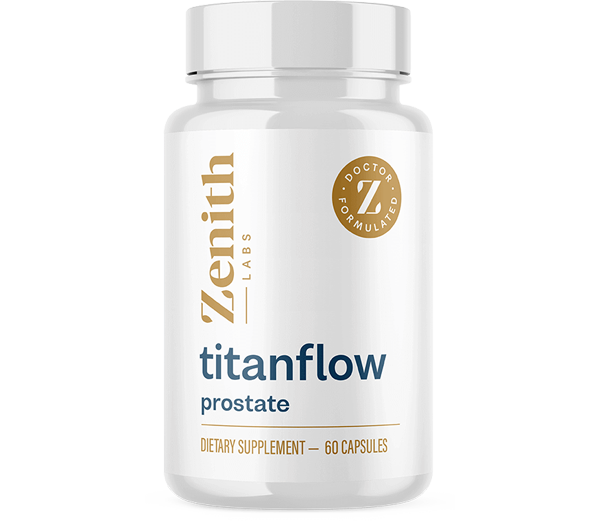
TitanFlow is a capsule dietary supplement from Zenith Labs, formulated by Dr. Ryan Shelton, N.D. It’s marketed as a prostate and urinary-flow support product aimed at men (typically over 40) dealing with the classic nuisances of an aging prostate: a weak or interrupted urine stream, frequent urination, getting up multiple times a night, and the sense of not fully emptying the bladder.
The marketing angle Zenith Labs leans on is that TitanFlow doesn’t only try to address the prostate gland itself — it claims to also target the urethra (the tube urine passes through). The pitch is that this “two-front” approach is why it supposedly works where simpler formulas don’t. That’s a reasonable-sounding mechanism, but treat it as a marketing claim rather than a proven advantage — we didn’t find head-to-head evidence that TitanFlow outperforms standard prostate blends.
It’s sold direct-to-consumer through the official website, with orders processed through ClickBank, a common third-party retail platform. It isn’t sold on Amazon or in retail stores, which (as with most ClickBank supplements) means there’s no neutral marketplace with a large pool of verified buyer reviews.
How It Claims to Work
The official positioning is that TitanFlow supports “healthy urinary flow” by calming inflammation around the prostate and protecting the urethra, so urine can pass more freely. The brand frames it as working gradually with consistent daily use rather than as an overnight fix.
Be clear-eyed about the language: “supports healthy flow” and “promotes prostate comfort” are structure/function claims that supplements are allowed to make — they are not the same as clinically treating benign prostatic hyperplasia (BPH). If your symptoms are significant, a supplement is not a substitute for a proper diagnosis.
TitanFlow Ingredients
Here’s where TitanFlow is genuinely a bit more credible than the average obscure ClickBank supplement: several of its named ingredients have real research behind them for prostate/urinary symptoms. Based on what the seller and third-party pages describe, TitanFlow is marketed as containing:
- Beta-sitosterol — a plant sterol that is one of the better-studied natural compounds for BPH-related urinary symptoms; some trials show modest improvement in flow and emptying. Marketed here to reduce swelling and support bladder emptying.
- Pygeum (African plum bark) — a traditional remedy with some clinical support for BPH urinary symptoms; thought to reduce inflammation and relax smooth muscle.
- Lycopene — an antioxidant from tomatoes, included to “protect the urethra’s cells”; evidence for prostate-specific benefit is weaker than for the two above.
An important honesty point: we could not confirm the exact doses. Beta-sitosterol and pygeum only work in studies at specific amounts, so “it contains the right ingredient” means little if the dose is below what trials used — and Zenith Labs does not clearly publish the per-capsule amounts. Some third-party pages also list additional ingredients beyond these three; where sources can’t agree on the full label, that usually means they’re echoing marketing copy rather than reading the bottle. Read the current Supplement Facts panel yourself before buying.
What Real Users Say
This is where we have to be straight with you. The marketing advertises an extremely high rating — around 4.9 stars from 21,000+ reviews — and many “TitanFlow reviews” pages repeat glowing testimonials about stronger streams and fewer night-time trips. But nearly all of that traces back to the seller’s own funnel or to affiliate sites that earn a commission on each sale. We treat those as advertising, not independent feedback.
We could not locate a large body of genuinely independent, verified user reviews. Claims that feedback is “verified across Trustpilot, Reddit, BBB and Quora” mostly appear on the affiliate pages themselves rather than as a substantial, organic presence we could confirm. For a product claiming tens of thousands of happy customers, the thinness of neutral third-party reviews is a yellow flag.
As for “TitanFlow complaints,” the negatives that surface are mostly soft and seller-friendly: results take several weeks, effects vary by person, and occasional shipping delays. Those read more like managed expectations than hard criticism. The honest negatives we’d actually flag are: undisclosed doses, no independent clinical testing of the TitanFlow blend (as opposed to its individual ingredients), single-retailer availability, and marketing that outruns the evidence.
Is TitanFlow a Scam?
Short answer: we found no evidence that TitanFlow is an outright scam. It’s a real product from an established brand (Zenith Labs), sold through ClickBank with a refund policy and a real formulator. The “scam” searches are mostly driven by people — reasonably — being skeptical of the aggressive marketing and the too-good-to-be-true review counts. That skepticism is healthy. But “the hype is overblown” is different from “the product is fake.” Our take: the marketing is inflated and the rave reviews are largely seller-controlled, so rely on the money-back guarantee rather than the testimonials.
Pricing, Guarantee & Where to Buy
TitanFlow is sold only through its official website. Pricing centers on multi-bottle bundles with a per-bottle discount (buying more lowers the per-bottle price, the standard Zenith Labs funnel). We did not confirm an exact current price, so check the live figure at checkout rather than trusting any number a review page quotes.
The genuinely reassuring part is the 180-day money-back guarantee — six months is well above the industry norm and meaningfully lowers your financial risk, since it gives you time to judge results and still request a refund. ClickBank’s standard refund process is a real safety net. Confirm the exact terms and window at checkout before you buy.
Check the latest pricing and the 180-day guarantee terms on the official site →
Pros and Cons
Pros
- Built around ingredients with some real research for BPH/urinary symptoms (beta-sitosterol, pygeum) — better evidence base than many prostate supplements
- Long 180-day money-back guarantee reduces financial risk
- Established brand (Zenith Labs) with a named formulator, not an anonymous label
- Marketed as made in a US, FDA-registered, GMP-certified facility
Cons
- Doses not clearly disclosed — and dose is what determines whether the good ingredients actually do anything
- No clinical testing of the actual TitanFlow blend
- The “4.9 from 21,000+ reviews” figure is seller-controlled; little verifiable independent feedback
- Aggressive marketing that runs ahead of the evidence
- Sold through one retailer only, no neutral review pool
Our Verdict
TitanFlow is a plausible, better-than-average-on-paper prostate supplement that’s still let down by the usual problems. The ingredient choices are smarter than most — beta-sitosterol and pygeum aren’t snake oil, and they have legitimate (if modest) support for urinary symptoms. That earns it a middle-of-the-road score rather than a low one. But “good ingredients” only matters at the right dose, and TitanFlow doesn’t clearly tell you the doses; meanwhile the studies cited are about the ingredients in general, not about TitanFlow itself.
It might suit you if: you specifically want to try beta-sitosterol/pygeum-based prostate support in one convenient capsule, you’re comfortable with the premium bundle pricing, and you’ll lean on the 180-day guarantee if it doesn’t help.
You should probably skip it (or see a doctor first) if: your urinary symptoms are significant or worsening, you want dose transparency and proof, or you take medication — and remember that prostate symptoms can have causes a supplement won’t address. Get checked.
If you do try it, buy only through the official site so the guarantee applies, and keep your refund window in mind.
See current availability and the guarantee on the official TitanFlow site →
FAQ
Does TitanFlow actually work?
Honestly, we can’t say it’s proven. Its key ingredients (beta-sitosterol, pygeum) do have some research support for BPH-related urinary symptoms, which is more than many competitors can claim — but we found no clinical testing of the TitanFlow formula itself, the doses aren’t disclosed, and the rave reviews are largely seller-controlled. Results, if any, would likely be gradual and vary by person.
Is TitanFlow a scam?
We found no evidence it’s a scam. It’s a real product from Zenith Labs sold through ClickBank with a 180-day refund policy. The marketing is aggressive and the review numbers are seller-controlled, so be skeptical of the hype — but that’s not the same as being defrauded. Use the guarantee rather than trusting the testimonials.
Are there side effects?
The named ingredients are generally well tolerated, but beta-sitosterol and pygeum can cause mild digestive upset in some people, and any prostate supplement can interact with medications or mask symptoms that need medical attention. Talk to your doctor before starting, especially if you take prescription drugs.
How long does it take to work?
The seller positions it as a gradual, several-weeks-of-consistent-use product, not an overnight fix. Note that this timeline still falls within the generous 180-day guarantee, so you can judge results and still request a refund if needed.
Where can I buy TitanFlow?
Only through the official TitanFlow (Zenith Labs) website — it isn’t sold on Amazon or in stores. Buying direct also ensures the 180-day money-back guarantee applies.
How we researched this: we anchored claims on Zenith Labs’ own TitanFlow marketing (primary source for the mechanism, guarantee, and ingredient names) and cross-checked ingredient evidence against general prostate-health research. We treated third-party “reviews” with caution because most are affiliate pages or press releases that echo the seller’s copy. Where we couldn’t verify a figure (exact doses, exact price, the 21,000-review rating), we flagged it instead of repeating it as fact.